If you are checking night shift pay in the uk, here is the direct answer: there is no separate legal night-shift rate. The law does not say that work after 11pm must be paid at a higher rate, and it does not set an unsocial-hours premium. What the law does give you is a floor under your pay, a limit on how many hours you can average at night, rest breaks, and a free health assessment. Any extra money for working nights comes from your contract, your staff handbook, or a collective agreement — not from the statute book.
That distinction matters. A job paying £14 an hour for nights and days is lawful, provided average pay does not fall below the National Minimum Wage for your age. A job promising an extra £2 an hour for nights must pay it, because a contractual promise is part of your pay.
What Counts as Night Work in the UK?
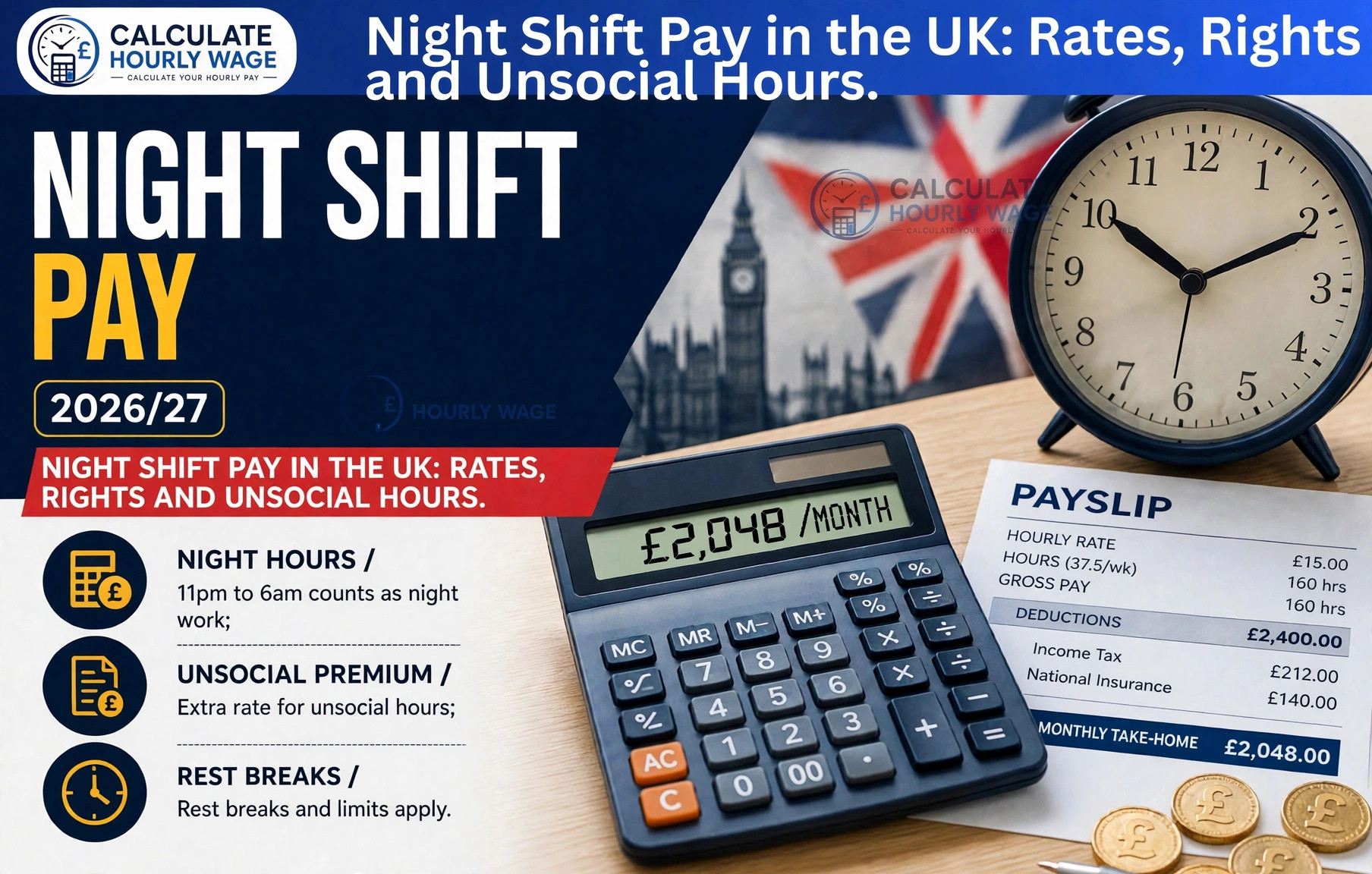
GOV.UK defines the night period as 11pm to 6am. You are a night worker if you regularly work at least three hours during that period. The word regularly matters. A single late finish that runs past 11pm does not, on its own, make you a night worker. A rota in which you normally work from 10pm to 6am, or from 11pm to 7am, does.
You and your employer can agree a different night period, but it must be agreed in writing, it must be at least seven hours long, and it must include midnight to 5am. A period of 10pm to 5am would meet that test; a period of 1am to 5am would not, because it is only four hours long. You can also be a night worker if a collective agreement, such as a trade union agreement, states that your work is night work.
Night work covers warehouse staff, care workers, hospital staff, security guards, hotel workers and factory staff on rotating shifts, although road, sea and air transport have their own rules. The rights here apply to workers, a wider group than employees alone, so agency and casual staff are generally covered too.
Is There a Legal Night Shift Rate? The Honest Answer
No. GOV.UK states this plainly: the National Minimum Wage applies to night workers, but there is not a higher night working rate. That sentence clears up the most common misunderstanding about night shift pay in the uk. There is no statutory time-and-a-half for nights, no statutory double time for nights, and no statutory unsocial-hours uplift.
The legal floor is the same floor that applies during the day. From 1 April 2026, the rates are £12.71 an hour for workers aged 21 and over, known as the National Living Wage, £10.85 an hour for workers aged 18 to 20, and £8.00 an hour for workers under 18 and for apprentices. Those rates apply until the next change, which normally comes each April. Rates announced for April 2027 — £13.21, £11.27 and £8.31 respectively — are not in force yet, so do not use them to check a 2026/27 payslip.
| Worker | Minimum hourly rate from 1 April 2026 |
|---|---|
| Aged 21 and over (National Living Wage) | £12.71 |
| Aged 18 to 20 | £10.85 |
| Under 18 | £8.00 |
| Apprentice | £8.00 |
The floor is tested on average pay for the hours worked, not on each hour in isolation. A night premium lifts that average if your contract pays it; without one, your average is simply your basic rate. Unpaid hours and deductions for uniform or accommodation can drag an average down, so the payslip total alone does not always tell the full story.
How Unsocial Hours Premiums Usually Work
Because the law sets no premium, it is whatever your contract says, and contracts vary a great deal. Common patterns are a fixed cash addition per hour, a percentage uplift, a higher rate for only part of the night, and a flat payment per shift. None is standard, so check the exact wording rather than assuming a previous job’s pattern.
A fixed addition is the easiest to check. If your basic rate is £13.50 an hour and your contract adds £2.00 an hour for hours worked between 11pm and 6am, your night rate is £15.50 an hour. A percentage uplift works the same way with one extra step: a 25% uplift on £14.00 an hour gives £14.00 × 1.25 = £17.50 an hour, while a 20% uplift on the same rate gives £16.80 an hour. A split rate is common where a shift straddles the night period: hours before 11pm might be paid at the basic rate, and only the hours from 11pm onwards attract the premium. A flat payment, such as £15 per night shift, is harder to compare with other jobs because its value per hour depends on shift length — £15 over an 8-hour shift is £1.88 an hour, but over a 12-hour shift it is £1.25 an hour.
Also check when the premium starts and stops. Some contracts pay it for the whole shift if any part falls in the night period; others pay it only for the hours inside the period. Some add a weekend or bank holiday premium on top, and some pay only the higher of the two. A single all-in rate, such as £16 an hour for nights, may already include the premium, so you cannot add one on top of it a second time. Always ask: what is my basic rate, what is my night rate, and which hours does each cover?

Worked Examples: Night Shift Pay You Can Check
Example 1: A warehouse worker, five nights a week
Amira works 10pm to 6am, five nights a week, an 8-hour shift each night, so 40 hours a week. Her basic rate is £13.50 an hour, and her contract adds £2.00 an hour for hours worked between 11pm and 6am. Each shift therefore has one hour at the basic rate, from 10pm to 11pm, and seven hours at the night rate of £15.50 an hour.
Per shift, her pay is (1 × £13.50) + (7 × £15.50) = £122.00. Over five shifts, her weekly gross pay is 5 × £122.00 = £610.00. Without the premium, the same 40 hours would pay £540.00, so the premium is worth £70.00 a week. Her average rate is £610.00 ÷ 40 = £15.25 an hour, above the £12.71 floor. Work out your own figure with our shift pay calculator.
Example 2: A care worker on waking nights
Daniel works waking nights from 11pm to 7am, four nights a week, so 32 hours a week. His basic rate is £12.71 an hour, the National Living Wage for workers aged 21 and over, and his contract pays a £1.50 an hour night premium. His night rate is therefore £14.21 an hour, and his weekly gross pay is 32 × £14.21 = £454.72. Without the premium, the same hours would pay 32 × £12.71 = £406.72, so the premium is worth £48.00 a week.
If his employer stopped paying the premium, his pay would fall to £406.72 a week but would still clear the floor, because £12.71 is the floor itself. The premium would be lost, but no minimum wage arrears would arise. Unpaid hours could still pull an apparently safe rate below the line, because the floor test counts hours actually worked.
Example 3: A part-time night worker, three nights a week
Priya works three 8-hour night shifts a week, 24 hours in total, at a basic rate of £15.00 an hour with a 25% night uplift. Her night rate is £15.00 × 1.25 = £18.75 an hour, so her weekly gross pay is 24 × £18.75 = £450.00. At her basic rate alone, the same hours would pay £360.00, so the uplift is worth £90.00 a week.
Part-time night workers are not excluded from these rights: the limits and the health assessment turn on regularly working at least three hours in the night period, not on being full-time. Part-time workers must also not be treated less favourably than comparable full-time workers.
These are illustrative contract examples, not official rates. Your own premium, if you have one, is the figure in your contract.
The 8-Hour Limit: How Many Hours Can You Work at Night?
Night workers must not work more than an average of 8 hours in a 24-hour period. The average is usually calculated over 17 weeks, but it can be over a longer period of up to 52 weeks if the workers and the employer agree, for example by collective agreement. Regular overtime is included in the average, but occasional overtime is not. Workers cannot opt out of this limit.
That last point is different from the 48-hour week. You can choose in writing to opt out of the 48-hour average limit, but there is no equivalent opt-out for the night-work limit. Signing a 48-hour opt-out does not remove the 8-hour night limit, and an employer cannot ask you to sign it away.
Averaging means a single 12-hour night does not automatically break the rule if shorter nights or rest days bring the average down. What breaks it is a pattern that stays above 8 hours on average, such as regular 10-hour nights five nights a week with no shorter weeks to balance them.
Where the work involves special hazards, or mental or physical strain, the limit is stricter: night workers in that position cannot work longer than 8 hours in any 24-hour period, not just on average. A risk assessment must be carried out to identify special hazards and work involving mental or physical strain. If your night work is heavy or hazardous, ask what the risk assessment says, because the absolute 8-hour limit may apply to you.
Rest Breaks and Rest Between Night Shifts
Night workers have the same rest rights as other adult workers, on top of the 8-hour limit. If you work more than six hours a day, you are entitled to one uninterrupted 20-minute rest break during your working day. The break does not have to be paid unless your contract says so, and it should be taken in the middle of the day, away from your workstation.
You are also entitled to 11 hours of rest between working days. GOV.UK gives the simple example: if you finish at 8pm, you should not start again until 7am the next day. For a night worker, a shift finishing at 6am should not be followed by a shift starting before 5pm the same day. Weekly rest is either an uninterrupted 24 hours without any work each week, or an uninterrupted 48 hours each fortnight.
These rest rights are where rotating rotas most often go wrong: a late shift followed by an early shift can leave far less than 11 hours between shifts. Check the gap between every pair of shifts, not just the weekly total.
Exceptions exist for the armed forces and emergency services, domestic staff in a private house, round-the-clock jobs such as hospital work, and peak-period industries such as agriculture, retail, tourism and security. Where the normal limits do not apply, workers must instead get compensatory rest of at least 90 hours a week on average. If you are told an exception applies to you, ask which one, and check with Acas if unsure.

The 48-Hour Week, Health Assessments and Sleep-In Shifts
The 48-hour rule sits alongside the night-work limit, and both must be satisfied. You cannot work more than 48 hours a week on average, normally over 17 weeks, unless you voluntarily opt out in writing, for a set period or indefinitely. Under-18s cannot work more than 8 hours a day or 40 hours a week, and those hours cannot be averaged out. Employers must keep night workers’ hours records for at least two years.
Employers must also offer night workers a free health assessment before they become a night worker, and regular assessments throughout their employment. You do not have to accept, but the offer must be made. If a health professional confirms night working has affected your health, your employer must find you other suitable work, where possible. Records of assessments, and of offers refused, must be kept confidentially for two years. If you have never been offered one, ask in writing and keep a copy.
Sleep-in shifts deserve a separate note. GOV.UK draws a line based on what you are expected to do for most of the shift. If you are expected to sleep for most of it, and you are provided with suitable sleeping facilities, you will only get the National Minimum Wage for periods when you are awake to perform tasks. If you are expected to work for most of it, you will get the National Minimum Wage for the whole shift, even if you may sleep between tasks. That rule is about the wage floor, not your contract: if your contract pays the whole shift, that rate applies. Keep a note of when you were woken and what you did.
Young workers aged 16 or 17 have stricter rules: they cannot work between midnight and 4am, and usually cannot work between 10pm and 6am, although a contract can change that to 11pm to 7am. Exceptions exist for agriculture, cultural, sporting, artistic or advertising activities, hospitals, hotels or catering, retail, and post or newspaper delivery. Even then, the employer must give a rest period as long as the extended shift.
What to Check on Your Contract and Payslip
Before you accept a night job, or before you query a payslip, work through this checklist. First, what is your basic hourly rate, and what, if anything, is your night rate? Second, which hours attract the night rate — the whole shift, or only the hours inside the night period? Third, does a weekend or bank holiday premium stack on top of the night premium, or does only the higher rate apply? Fourth, how are sleep-in shifts paid? Fifth, what does your rota average over 17 weeks, and does it stay within the 8-hour night limit and the 48-hour week? Sixth, have you been offered a free health assessment, and when was the last one?
On the payslip, check that night hours are shown separately, with their own rate, so you can divide night pay by night hours and compare it with your contractual night rate. If only a lump sum is shown, ask payroll for the breakdown, and raise any shortfall promptly, while rotas and timesheets are still to hand.
If payroll’s answer does not match your contract, query it in writing, giving the pay period, hours worked, rate promised and rate paid, and ask for the calculation in writing. If it still does not resolve, Acas offers free and confidential advice. Do not rely on a colleague’s pay, because their contract may differ from yours.
Night shift pay in the uk is therefore a two-part question. The law gives you a wage floor, an 8-hour average limit, rest breaks, and a free health assessment. Your contract gives you, or does not give you, the extra money for unsocial hours. Once you know both, you can check any night rota — or work out your own figure with our shift pay calculator.
Frequently Asked Questions
Do employers have to pay extra for night shifts in the UK?
No. There is no statutory night premium. GOV.UK states that the National Minimum Wage applies to night workers but there is not a higher night working rate. Any extra pay for nights must come from your contract, handbook, or collective agreement.
What is night shift pay in the uk, in simple terms?
It is whatever your contract pays for night hours, subject to the legal wage floor: from 1 April 2026, £12.71 an hour for workers aged 21 and over, £10.85 for ages 18 to 20, and £8.00 for under-18s and apprentices. A common pattern is a basic rate plus a fixed addition or percentage uplift for night hours.
How many hours can I work at night?
As a night worker, you must not work more than an average of 8 hours in a 24-hour period, usually averaged over 17 weeks, and you cannot opt out of that limit. If your work involves special hazards or mental or physical strain, the limit is an absolute 8 hours in any 24-hour period. Regular overtime counts towards the average; occasional overtime does not.
Am I entitled to a free health assessment for night work?
Yes. Your employer must offer you a free health assessment before you become a night worker and offer regular assessments throughout your employment. You do not have to accept, but the offer must be made. If a health professional confirms night work has affected your health, your employer must find you other suitable work, where possible.
Do night workers get rest breaks and rest between shifts?
Yes. Over six hours a day gives one uninterrupted 20-minute break, plus 11 hours between working days and either 24 hours weekly rest or 48 hours each fortnight. Where an exception applies, compensatory rest of at least 90 hours a week on average applies instead.
Can I refuse night work, or opt out of the night-work limit?
You can only be required to work nights if your contract says so, and you cannot opt out of the 8-hour night-work limit — unlike the 48-hour week, where a written voluntary opt-out is possible. For advice on your situation, contact Acas.