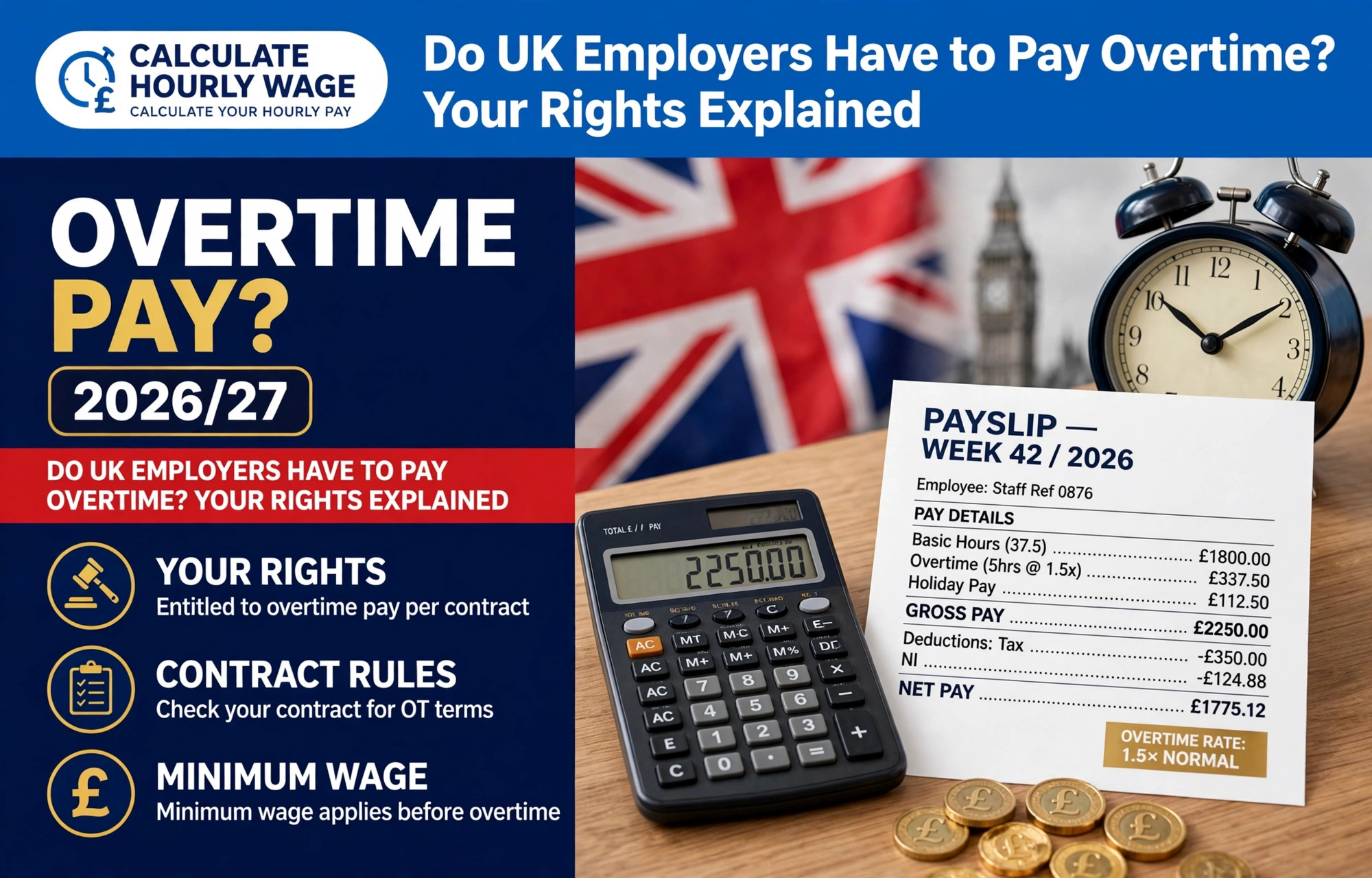
If you are asking whether do employers have to pay overtime in the uk, the short answer is no — not as a general legal right. UK law does not force an employer to pay you extra simply because you worked beyond your normal hours, and it sets no statutory overtime rate such as time and a half. What the law does do is protect you in three other ways: your contract, if it promises overtime pay, must be honoured; your average pay across all the hours you work must not fall below the National Minimum Wage or National Living Wage; and you cannot usually be forced to work more than 48 hours a week on average unless you have agreed in writing to opt out.
That distinction catches a lot of people out. Many workers assume staying late automatically earns a higher rate, and many employers assume a salary means extra hours are free. Neither is quite right. The real question is almost always the same: what does your contract say, and does your total pay still clear the legal floor once every hour worked is counted?
Do Employers Have to Pay Overtime in the UK?
GOV.UK states the position plainly on its overtime rights page: employers do not have to pay workers for overtime, but average pay for the total hours worked must not fall below the National Minimum Wage. Your employment contract will usually include details of any overtime pay rates and how they are worked out. In other words, overtime pay in the UK is a contractual matter, not a statutory one.
That has a practical consequence worth understanding first. If your contract says overtime is paid at your normal hourly rate, that is what you are owed — no more, no less. If it says time and a half, that enhanced rate becomes part of your contract and your employer must pay it. If it says nothing, or says overtime is unpaid, extra hours may genuinely be unpaid, provided the minimum wage floor is still met and the hours themselves are lawful. A verbal promise is harder to prove than a written clause, which is why the first step in any overtime dispute is to read the contract itself, including any staff handbook it refers to.
It also means there is no single UK overtime rate to look up. Time and a half, double time, a flat Sunday premium, and time off in lieu are all common arrangements, but every one comes from a contract or collective agreement — not from an Act of Parliament. Anyone who tells you UK law guarantees time and a half is confusing a common contract term with a legal right.
What Counts as Overtime in the UK?
Overtime usually means any time you work beyond your normal working hours, and your normal working hours are the hours fixed by your employment contract. That definition matters because the trigger point is different for every worker. For a full-time worker contracted to 37.5 hours a week, the 38th hour is overtime. For a part-time worker contracted to 20 hours, the 21st hour is extra work, but whether it counts as paid overtime depends on the contract — a point covered in detail later in this guide.
There is no legal working week after which overtime pay automatically starts. Some contracts set the threshold at your own contracted hours, some at the full-time hours for your role, and some only for hours outside a rota or at unsocial times. Shift workers should check whether weekend, night, or bank holiday hours count as overtime at all, or as ordinary shift hours. If you work a rotating pattern, our shift pay calculator can help price a week of shifts, but the contract still decides which hours attract a premium.
Keep your own record of the hours you actually work, including start and finish times. Payslips show what you were paid, not necessarily what you worked, and a simple note of your hours is far more persuasive than a memory of a busy week if you ever query a payment. Our guide to how to read your payslip explains where overtime should appear on it.
Can Your Employer Make You Work Overtime?
You only have to work overtime if your contract says so. That is the second key rule on the GOV.UK overtime page, and it splits overtime into two types that every worker should recognise.
Compulsory overtime means your contract requires you to work extra hours when your employer reasonably asks. Even then, there are limits: by law, you cannot usually be forced to work more than an average of 48 hours per week, and you can agree to work longer only through an agreement that is in writing and signed by you. If your contract does not require overtime, you can refuse it, and your employer cannot dismiss you or treat you unfairly simply for refusing hours you never agreed to work.
Voluntary overtime is the other side of the coin. Your employer may offer extra hours, and you may accept or decline them. Unless your contract guarantees you overtime, your employer can also stop offering it. What your employer cannot do is hand overtime out on discriminatory grounds — for example, stopping some employees from working overtime while letting others do so. If overtime dries up for you alone after a complaint, get advice rather than treating it as ordinary rota management.
Guaranteed overtime deserves a special mention: some contracts guarantee a set amount each week, treated as part of your normal working pattern. Non-guaranteed overtime, where the employer need not offer it but you must work it if offered, sits in between. Check which kind your contract describes, as it affects your pay and how average hours are calculated for other rights.

The Minimum Wage Floor: The One Payment Rule That Always Applies
Even where overtime is unpaid by contract, one payment rule always applies: your average pay for the total hours you work must not fall below the National Minimum Wage or National Living Wage. This catches salaried workers most often, because a salary that looks comfortable over a 40-hour week can fall below the floor once regular unpaid extra hours are counted. From 1 April 2026, the rates are £12.71 an hour for workers aged 21 and over (the National Living Wage), £10.85 for ages 18 to 20, and £8.00 for under-18s and apprentices.
| Worker | Minimum hourly rate from 1 April 2026 |
|---|---|
| Aged 21 and over (National Living Wage) | £12.71 |
| Aged 18 to 20 | £10.85 |
| Under 18 | £8.00 |
| Apprentice | £8.00 |
Worked example: how unpaid overtime can breach the floor
Take a worker paid a salary of £28,000 a year, contracted to 40 hours a week. Over a year that is 40 × 52 = 2,080 hours, so the average hourly rate is £28,000 ÷ 2,080 = £13.46 an hour. That clears the £12.71 National Living Wage comfortably.
Now suppose the same worker regularly works 50 hours a week with no overtime pay. Annual hours become 50 × 52 = 2,600, and the average rate falls to £28,000 ÷ 2,600 = £10.77 an hour — below the £12.71 floor. The shortfall is £1.94 an hour, about £97 a week at 50 hours, and the employer would owe arrears to bring average pay back to the legal minimum, even though the contract said nothing about overtime pay. This is a simplified yearly average — the formal calculation works over pay reference periods — but the principle is the same: unpaid hours still count when the floor is tested. To check your own position, divide your salary by your real weekly hours multiplied by 52 using our salary to hourly calculator.
How Overtime Pay Usually Works in Practice
Where a contract does pay overtime, four arrangements cover almost every workplace. Knowing which one you are on prevents most payslip surprises.
First, overtime at your normal hourly rate: extra hours are paid exactly like ordinary hours. It is common where the employer wants flexibility without a premium, and lawful as long as the minimum wage floor is met.
Second, overtime at an enhanced rate, most often time and a half. This is a contractual premium, not a legal one: your hourly rate multiplied by 1.5. Some contracts pay double time for Sundays or bank holidays, or a different premium for nights. Always check whether the premium applies to all overtime or only to hours beyond a higher threshold, such as hours over 40 a week rather than over your own 37.5-hour contract.
Third, time off in lieu, known as TOIL. Instead of paying for extra hours, the employer gives paid time off of equivalent value, on terms agreed with your employer, including when it can be taken. TOIL only works if the agreement is clear: how much time you earn per extra hour, how long you have to use it, and what happens to unused TOIL when you leave.
Fourth, overtime included in your salary. Some senior roles have contracts stating the salary covers a reasonable amount of additional hours. What counts as reasonable is the argument that follows — but such a clause does not remove the minimum wage floor or the 48-hour average limit.
Worked example: the same extra hours, three different outcomes
Take a worker paid £14 an hour, contracted to 37.5 hours a week, who works 5 extra hours in a week.
| Arrangement | Extra pay for 5 hours | Weekly total |
|---|---|---|
| Normal rate (£14 an hour) | 5 × £14 = £70 | £525 + £70 = £595 |
| Time and a half (£21 an hour) | 5 × £21 = £105 | £525 + £105 = £630 |
| Unpaid, if the contract allows it | £0 | £525 |
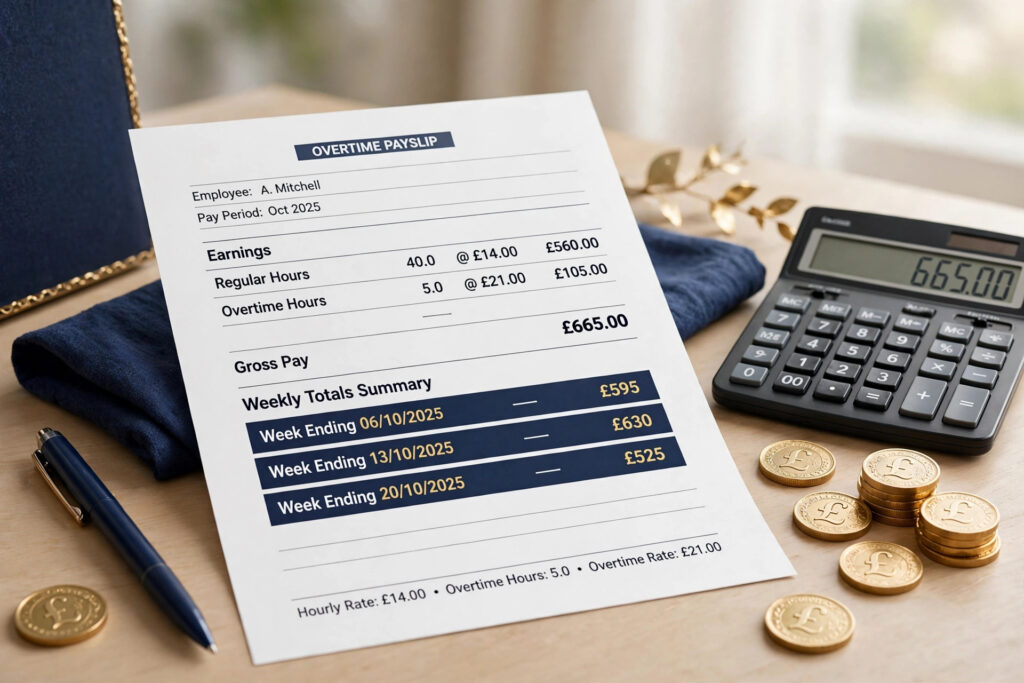
The difference between the normal-rate and time-and-a-half outcomes is £35 for a single week — £1,820 over a year if the pattern repeats weekly. That is why the exact wording of the overtime clause matters more than any general statement about overtime rights. If your contract promises a premium, work out what it is worth with our overtime pay calculator.
Part-Time Workers and Overtime
Part-time workers must not usually be treated less favourably than comparable full-time staff, but overtime is where they are most often confused. GOV.UK explains that a part-time worker will normally be paid their ordinary hourly rate for hours beyond their own contract, and will usually only receive a premium if full-time staff would also receive extra pay for those hours. That means two tests: if you work more than the normal full-time hours for the same job, and full-time staff would get extra pay for those hours, you should too; and if you work at unsocial times where full-time staff would get more pay, you should too.
Worked example: part-time hours, no premium yet
A part-time worker contracted to 20 hours a week at £13 an hour earns £260 a week. In one week she works 30 hours: the 10 extra hours are normally paid at £13, adding £130, for £390. If full-time staff in the same role are contracted to 37.5 hours and only earn a premium beyond 37.5 hours, she has not yet reached the premium threshold, even though she worked 10 hours beyond her own contract — the premium simply has not been triggered. If she worked 40 hours instead, the 2.5 hours beyond the full-time threshold would normally attract the full-time premium.
Our guide to part-time salary to hourly pay works through pro-rata calculations in more detail, and it is worth reading alongside this section if your hours vary from week to week.
The 48-Hour Week and the Rest Breaks That Limit Overtime
Overtime is also limited by working-time rules that have nothing to do with pay. You cannot work more than 48 hours a week on average, normally averaged over 17 weeks. A single 55-hour week does not break the rule if quieter weeks bring the average back to 48 or below — over 17 weeks, the ceiling is 48 × 17 = 816 hours.
| Rule | What it means |
|---|---|
| Maximum weekly hours | 48 hours a week on average, normally over 17 weeks. |
| Opting out | Over-18s may agree in writing to work more; refusal must not lead to dismissal or unfair treatment. |
| Rest break during the day | One uninterrupted 20-minute break if you work more than 6 hours. |
| Daily rest | 11 hours’ rest between working days. |
| Weekly rest | 24 uninterrupted hours each week, or 48 hours each fortnight. |
You can choose to work more than 48 hours on average by opting out, but the opt-out must be voluntary and in writing, and you can cancel it — your contract or the agreement itself will say how much notice you must give, up to 3 months. An opt-out does not waive your rest breaks, your daily rest, or your annual leave. If you have not opted out and your average creeps above 48, the fix is either a signed opt-out or fewer hours, not simply paying for the extra time.
Rest breaks matter for overtime too: a long overtime shift still attracts the same break rights, and a late finish followed by an early start can breach the 11-hour daily rest rule even if total weekly hours look acceptable.
What to Do If Your Overtime Pay Is Wrong
If your overtime pay does not match what you expected, work through four steps in order, and keep notes at each stage.
First, read your contract and any handbook it incorporates. Note the exact overtime clause: the threshold, the rate, whether TOIL applies, and whether overtime must be authorised in advance. Unauthorised overtime is a common reason for non-payment, and if your contract requires prior approval, hours worked without it may not be payable even if you genuinely worked them.
Second, check your payslip line by line. Overtime should appear as its own line or be clearly included in your gross pay, with the hours and rate identifiable. If the payslip is unclear, ask payroll for a breakdown in writing rather than accepting a verbal explanation.
Third, raise it with your employer in writing, quoting the contract clause and showing your hours and your calculation. Keep the tone factual: the hours worked, the rate promised, the amount paid, and the difference. Many overtime errors are payroll mistakes — a wrong rate, a missed week, a threshold applied incorrectly — and a clear written query resolves them quickly.
Fourth, if the employer will not correct it, get free advice from Acas, which GOV.UK points workers to for working-hours questions. Where pay has fallen below the minimum wage, HMRC enforces that separately, and a complaint can lead to arrears being recovered. This guide is general information, not legal advice for a specific dispute, so take advice on your own contract before taking formal action.
Finally, a note on holiday: the calculation for a week of leave is not always the same as a week of ordinary pay. To see what your leave is worth on your own figures, use our holiday pay calculator alongside your contract’s overtime terms.
The Bottom Line on Overtime Pay in the UK
Do employers have to pay overtime in the uk? As a matter of law, no — but that short answer hides the parts that actually protect you. Your contract decides whether overtime is paid, at what rate, and from what threshold. The minimum wage floor decides whether unpaid or low-paid overtime is lawful at all. And the 48-hour average, with its rest breaks, decides how much overtime you can be asked to work. Check those three things — contract, floor, and weekly average — before you work the next extra hour, and if your contract does pay overtime, run your hours through our overtime pay calculator and compare the result with your payslip.
Frequently Asked Questions
Do employers have to pay overtime in the UK?
No, not as a general legal right. GOV.UK states that employers do not have to pay workers for overtime. Overtime pay depends on your contract: if it promises a rate, your employer must pay it, and average pay across all hours worked must not fall below the National Minimum Wage.
Is time and a half a legal right in the UK?
No. There is no statutory time-and-a-half rate in UK law. Time and a half is a common contractual premium, worth 1.5 times your normal hourly rate, but it applies only if your contract, collective agreement, or established workplace terms provide for it.
Can my employer force me to work overtime?
Only if your contract says so. You only have to work overtime if your contract requires it, and even then you cannot usually be forced to work more than an average of 48 hours per week unless you have agreed in writing to opt out of the 48-hour limit.
What happens if unpaid overtime takes my pay below the minimum wage?
Your employer must make up the shortfall. Average pay must not fall below the National Minimum Wage — £12.71 an hour from 1 April 2026 for workers aged 21 and over, £10.85 for ages 18 to 20, and £8.00 for under-18s and apprentices. HMRC enforces the minimum wage where an employer does not correct an underpayment.
Do part-time workers get overtime pay?
Part-time workers are normally paid their ordinary hourly rate for hours beyond their own contract. An overtime premium usually applies only once they work beyond the normal full-time hours for the role, or at unsocial times where full-time staff would receive extra pay — unless their contract says something different.
Can I get time off instead of overtime pay?
Yes, if that is what your contract or agreement provides. Time off in lieu (TOIL) means extra hours are repaid as paid time off rather than cash, on terms agreed with your employer, including when the time off can be taken and what happens to unused TOIL.