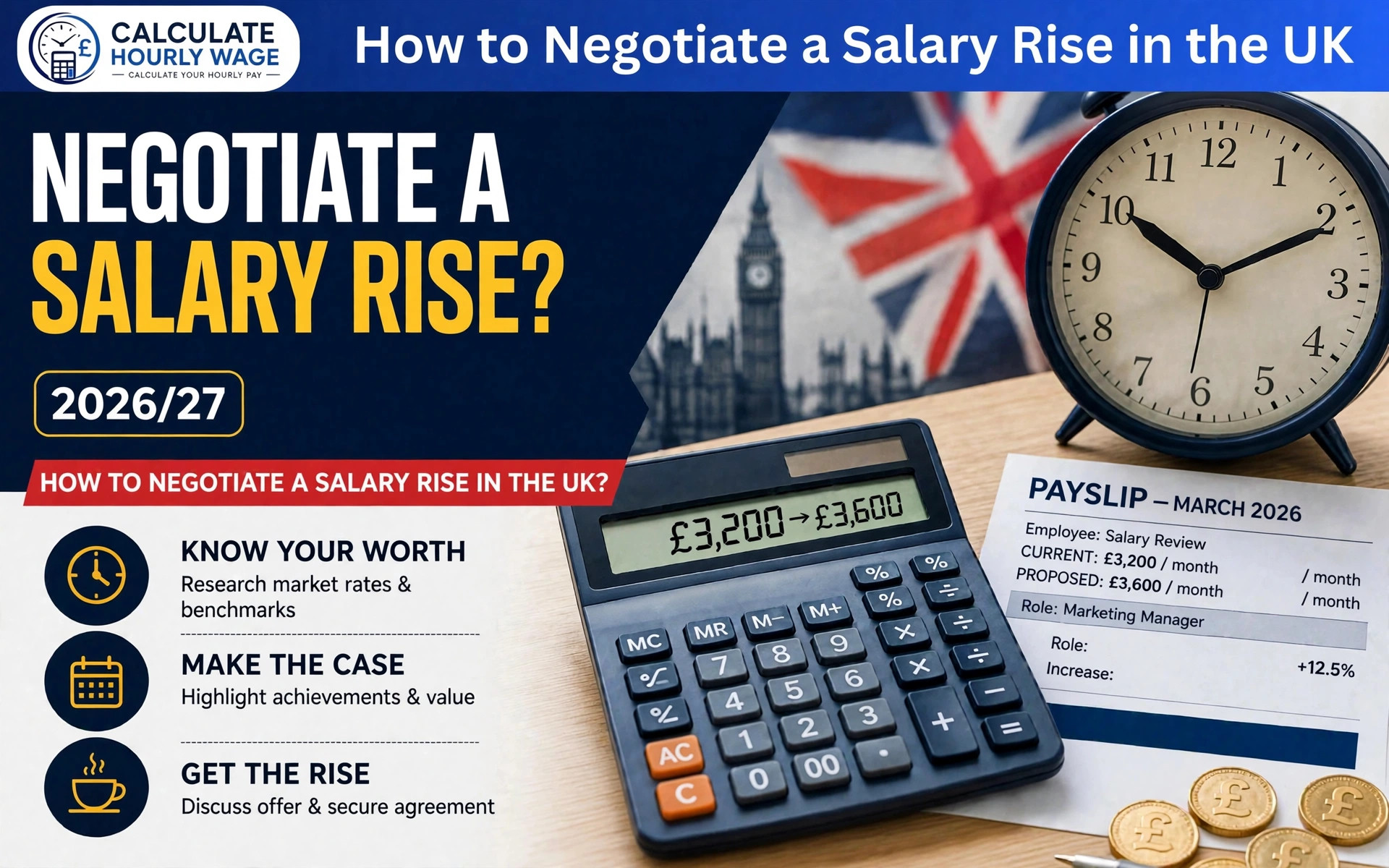
If you want to know how to negotiate a salary rise in the UK, the short answer is this: go in with a specific number, a short list of reasons you have earned it, and a clear idea of what that rise is worth after tax. Most pay negotiations fail not because the manager says no, but because the employee never asks, or asks vaguely for “a bit more” and leaves the manager with nothing concrete to approve. A specific ask — “I would like my salary reviewed from £32,000 to £35,200” — is much easier to say yes to than a general complaint that pay has not kept up.
This guide walks through the whole process in order: whether you have any legal right to a rise, how to pick your number, what the rise is actually worth once tax and National Insurance are taken off, how to build your case, what to say in the meeting, and what to do if the answer is no. Every official figure in it comes from GOV.UK, and the worked examples use the 2026/27 tax year, which runs from 6 April 2026 to 5 April 2027.
Do Employers Have to Give You a Pay Rise?
In most cases, no. There is no general legal right to an annual pay rise in the UK. Your employer must pay you at least the National Minimum Wage or National Living Wage for your age, and must honour whatever your contract says about pay reviews, but beyond that, rises are a matter of negotiation, not entitlement. That is worth knowing before you walk into the meeting, because it changes your approach: you are making a business case, not claiming a right.
The one hard floor is the legal minimum. From 1 April 2026, the rates are:
| Age | Hourly rate from 1 April 2026 |
|---|---|
| 21 and over (National Living Wage) | £12.71 |
| 18 to 20 | £10.85 |
| 16 to 17 | £8.00 |
| Apprentice | £8.00 |
These rates come from GOV.UK, and they rise every April. The rates already announced for April 2027 are £13.21 for workers aged 21 and over, £11.27 for 18 to 20-year-olds, and £8.31 for younger workers and apprentices. That matters for your timing: if you are paid close to the minimum, part of your rise may arrive automatically in April anyway, so a negotiation now should aim above the April 2027 floor, not just above today’s rate.
To see what the floor means in annual terms, a full-time worker aged 21 or over on the National Living Wage earns £24,784.50 a year on a 37.5-hour week (£12.71 × 37.5 hours × 52 weeks), or £26,436.80 on a 40-hour week. If your salary is anywhere near those figures, your first argument is simple: the legal floor is rising, and your pay should not be left standing still while it moves.
Check your contract too. Some contracts promise an annual review, a rise linked to inflation, or progression up a pay scale. If yours does, that is your starting point — you are not asking for a favour, you are asking for what was agreed. If it does not, you are still in a strong position as long as you can show your value, which is what the next sections are about.
Step 1: Work Out Your Number Before You Ask
Never walk into a pay conversation without a number. “I want more money” gives your manager nothing to work with and makes it easy to stall you with a vague promise to “look into it”. A number forces a real conversation.
Start with your current salary and decide what percentage rise you are asking for. For most people, a realistic ask is somewhere between 5% and 10%, depending on how long it is since your last rise and how much your role has grown. A 5% ask is modest and hard to argue against if you have a solid year behind you. A 10% ask needs a stronger case — new responsibilities, a role that has clearly outgrown its original description, or a long period without any rise at all. Asking for 20% or more usually only works if your job has fundamentally changed or you have a competing offer, and it risks making the whole conversation feel unrealistic.
Here is what those percentages look like on common salaries:
| Current salary | Ask for 5% | Ask for 10% |
|---|---|---|
| £28,000 | £29,400 | £30,800 |
| £32,000 | £33,600 | £35,200 |
| £40,000 | £42,000 | £44,000 |
Pick one figure as your ask and one as your walk-away minimum — the lowest figure you would accept happily rather than resentfully. Keep the minimum to yourself. If you announce it, the negotiation ends there, because no manager will offer more than the lowest number you have said you will accept.
It also helps to translate your ask into an hourly rate, because that is often how your own sense of the job works. A £35,200 salary on a 37.5-hour week is £18.05 an hour (£35,200 ÷ 1,950 annual hours), while £32,000 on the same hours is £16.41 an hour. Framing it that way can make the gap feel concrete: you are asking for £1.64 an hour more, in return for the extra work you are already doing. If you want to check the hourly equivalent of any salary, our annual salary calculator gives you the monthly and hourly figures straight away, so you can walk in knowing exactly what your current pay and your target pay are worth.
Step 2: Check What Your Rise Is Really Worth After Tax

A £3,200 gross rise is not £3,200 in your pocket. Income tax and National Insurance come off first, and the amount that comes off depends on which tax band you are in. Working this out before the meeting stops two mistakes: asking for too little because you overestimated the deductions, or being disappointed afterwards because you expected the full gross figure.
For the 2026/27 tax year, the figures for England, Wales and Northern Ireland are set by GOV.UK: the first £12,570 of your income is tax-free (the Personal Allowance), then you pay 20% basic-rate tax up to £50,270, 40% higher-rate tax up to £125,140, and 45% above that. Employee National Insurance is 8% on earnings between £12,570 and £50,270, and 2% above £50,270. That means that in the basic-rate band, you keep 72p of every extra £1 (after 20% tax and 8% National Insurance), and in the higher-rate band you keep 58p of every extra £1 (after 40% tax and 2% National Insurance).
Here is what that means in practice, assuming a standard tax code, no pension contributions and no student loan:
| Salary | Income tax | National Insurance | Take-home pay | Monthly take-home |
|---|---|---|---|---|
| £28,000 | £3,086 | £1,234.40 | £23,679.60 | £1,973.30 |
| £29,400 | £3,366 | £1,346.40 | £24,687.60 | £2,057.30 |
| £32,000 | £3,886 | £1,554.40 | £26,559.60 | £2,213.30 |
| £35,200 | £4,526 | £1,810.40 | £28,863.60 | £2,405.30 |
| £40,000 | £5,486 | £2,194.40 | £32,319.60 | £2,693.30 |
| £44,000 | £6,286 | £2,514.40 | £35,199.60 | £2,933.30 |
So a 10% rise from £32,000 to £35,200 puts an extra £192 a month in your pocket. A 5% rise from £28,000 to £29,400 is worth an extra £84 a month. Those are the numbers that matter when you are deciding whether an offer is worth accepting — not the gross figure in the headline.
Take the example of someone moving from £32,000 to £35,200. The gross rise is £3,200 a year. The tax on the extra £3,200 is £640 (20% of £3,200) and the National Insurance is £256 (8% of £3,200), so £896 comes off and £2,304 a year, or £192 a month, reaches the bank account. Knowing that figure in advance means you can judge an employer’s counter-offer on the spot instead of going home to work it out and wishing you had pushed a little harder.
One trap to watch for is the higher-rate threshold. If a rise takes you across £50,270, the slice above that line is taxed at 40% and charged National Insurance at 2%, so you keep 58p in the pound on that slice instead of 72p. Take a rise from £48,000 to £52,000: the gross rise is £4,000, but the take-home pay moves from £38,079.60 to £40,717.40, a gain of £2,637.80 a year or about £219.82 a month. That is still a rise very much worth having, but it is smaller per pound than a rise entirely inside the basic-rate band, and it is better to know that before you celebrate the gross figure. Our annual salary calculator will run these figures for any salary you enter, including the split between tax and National Insurance.
Step 3: Build a Case Your Manager Can Say Yes To
Managers approve rises they can defend to their own boss. “I work hard” is true of almost everyone and defends nothing. A case built on specifics is much harder to refuse, and it gives your manager the wording to use when they argue for you upstairs.
Start by writing down what has changed since your last pay review. Have you taken on tasks that used to belong to someone more senior? Are you training new starters, covering a second role, handling bigger clients, or holding a qualification you did not have a year ago? Put numbers on it where you can: revenue you brought in, complaints you resolved, time you saved, a project you delivered early. One page of specifics beats ten minutes of general praise for yourself.
Next, look at the market. Job adverts for the same role in your area show what other employers are currently offering, and that is fair material for a conversation — not as a threat, but as context. If similar roles are advertised well above your current pay, your manager already knows they would pay more to replace you, and reminding them of that fact politely is entirely reasonable. You do not need to quote salary-survey averages, which are often out of date or based on different roles; live adverts for the same job title are fresher and harder to dismiss.
Timing matters as much as content. The best moments are your annual appraisal, just after you have delivered something visible, or before budgets are set for the next year — asking after the budget is locked is asking your manager to find money that no longer exists. Avoid asking in the middle of a crisis, during redundancies, or on a day when your team is under obvious pressure. And remember the April minimum wage rise: if your pay is close to the legal floor, raising the subject before April lets your manager fold the statutory rise and your negotiated rise into one decision, which is administratively easier for them than two separate changes.
Step 4: The Conversation Itself

Keep it short, calm and specific. A good opening covers three things in under a minute: what you are asking for, why you have earned it, and an invitation for your manager to respond. Something like this works well:
“I would like to talk about my salary. Since my last review, I have taken on [specific responsibility] and [specific achievement]. I would like my salary reviewed from £32,000 to £35,200, which I think reflects the role as it is now. I wanted to discuss it with you before anything is decided for next year.”
Then stop talking. Let your manager answer. The silence after an ask feels awkward, but filling it usually means talking yourself down — offering to accept less before anyone has even said no.
A few things to avoid. Do not compare yourself to a named colleague’s pay; it puts your manager on the defensive and can breach workplace trust. Do not threaten to leave unless you genuinely mean it and have somewhere to go; an empty threat that is called destroys your credibility for the next conversation. Do not apologise for asking. You are discussing the price of your work, and that is a normal business conversation, not a personal favour.
If the answer is yes, agree the figure, the date it starts, and whether anything else changes with it, such as your hours or your job title. If the answer is “not now”, ask what specifically would need to change for the answer to become yes, and by when. “We will see what we can do” is not an answer — a date and a condition are. If the answer is a flat no on salary, do not walk away empty-handed: ask about the alternatives. A bonus, extra annual leave, a training budget, a professional qualification, flexible hours, or a formal review date in three months are all real value, and they are often easier for a manager to approve than a salary change. A review date in writing is worth more than a verbal promise, because it turns a refusal into a timetable.
Step 5: Get It in Writing and Check Your Payslip
Whatever is agreed, get it in writing before you celebrate. An email confirming the new salary, the start date and any other agreed changes protects both sides, and it gives payroll something unambiguous to act on. Salary changes are a common source of payroll errors, so when the first payslip at the new rate arrives, check it line by line: the gross pay, the tax code, the National Insurance deduction and the net pay. Our guide on how to read your payslip explains every line, so you can spot quickly whether the rise has been applied correctly or whether payroll has used the wrong figure or the wrong start date.
It is also worth checking the knock-on effects. A rise changes your hourly rate, which matters if you are ever comparing a salaried role with an hourly-paid one — our article on salary vs hourly pay walks through that comparison in full. And if you are weighing a rise against a move to a different salary altogether, running both figures through the annual salary calculator first shows you the monthly difference after tax, which is the figure your household budget actually feels. For a broader sense of what a given salary means month to month, our breakdown of £40,000 after tax shows the same method applied to a single salary from gross pay to bank account.
Finally, keep a note of the conversation and the outcome. If a review date was promised, put it in your calendar and raise it yourself when it arrives — managers change, budgets move on, and a rise that depends on someone remembering a hallway promise is a rise that quietly never happens.
Frequently Asked Questions
Do employers have to give a pay rise every year?
No. There is no general legal duty to raise pay each year. Your employer must pay at least the National Minimum Wage or National Living Wage and must follow your contract, but annual rises are normally a matter of negotiation or company policy, not law.
How much of a salary rise should I ask for in the UK?
For most people, between 5% and 10% is realistic if your role has grown or it has been a year or more since your last rise. A larger ask needs a stronger reason, such as a major change in responsibilities or a competing offer. Always ask for a specific figure, not a vague increase.
When is the best time to ask for a pay rise?
At your annual appraisal, just after a visible success, or before next year’s budgets are set. Avoid asking during redundancies or a crisis. If you are paid near the legal minimum, raising it before the April minimum wage uprating lets your manager handle both changes together.
What should I do if my employer says no?
Ask what would need to change for the answer to become yes, and agree a review date in writing. Also ask about alternatives that carry real value: a bonus, extra leave, training, a qualification, or flexible hours. A dated review is far better than a vague promise to revisit it.
How much of a pay rise do I actually keep after tax?
In the basic-rate band you keep 72p of every extra £1, after 20% income tax and 8% National Insurance. Above the £50,270 higher-rate threshold you keep 58p of every extra £1, after 40% tax and 2% National Insurance. A £3,200 rise from £32,000 to £35,200 is worth £192 a month in take-home pay.
Should I mention another job offer in a pay negotiation?
Only if the offer is real and you would genuinely take it. A genuine offer is strong evidence of your market value. A bluff that is called damages your credibility, so never invent an offer or exaggerate one you do not have.
Sources
- GOV.UK — National Minimum Wage and National Living Wage rates: https://www.gov.uk/national-minimum-wage-rates
- GOV.UK — Income Tax rates and Personal Allowances: https://www.gov.uk/income-tax-rates
- GOV.UK — National Insurance rates and categories: https://www.gov.uk/national-insurance-rates-letters/print
- GOV.UK — Minimum wage rates announced for April 2027: https://www.gov.uk/government/news/lpc-recommendations-take-the-national-living-wage-to-1321